TOYAH — While Railroad Commissioner Christi Craddick has proclaimed that there is no widespread problem with plugged and/or abandoned oil wells leaking produced water, 200-foot geysers such as the one that erupted last Wednesday (Oct 2) a few miles west of Toyah suggest that there may very well be a problem.
The Toyah blowout is the most recent in a string of leaking wells reported to the Texas Railroad Commission. The first was another spectacular geyser of toxic produced water that appeared New Year’s Day 2022 in western Crane County.
Since then there has seemed to be a steady march westward of old wells coming to life to spew produced water to the surface from western Crane county, into and through Pecos and Ward counties, and now into Reeves County.
The most recent before the Toyah blowout took place on Labor Day weekend, north of Barstow. Railroad Commission (RRC) contractors are still working at that location to try and contain and plug the well.
Local rancher Schuyler Wight has been speaking at RRC monthly meetings for several years to try and bring the issue to the Commission’s attention, but so far has been given a very cold shoulder by Craddick and the other two commissioners, Wayne Christian and Jim Wright.
“This is not a problem they want to notice,” Wight said. Wight has scores of leaking wells in his pastures scattered across the Permian.
However, perhaps nudged by Wight and other west Texan’s vocal efforts at meeting, Craddick, who is a Midland native and daughter of Texas House of Representatives Speaker Tom Craddick, published an opinion piece in the Odessa American the last week of August.
In the piece she perhaps infamously wrote, “Recent media reports from West Texas have regurgitated false claims that there is a widespread epidemic of previously plugged oil and gas wells leaking across Texas. That could not be further from the truth.”
Farmers and ranchers in Reeves, Ward, Pecos and Crane counties might take issue with how Craddick defined “widespread epidemic.”
In the following six weeks another well was reported to the RRC in Pecos County, the previously mentioned bore in Ward County erupted, and now the abandoned hole in Reeves County has come to unwelcome life.
While many of the reported leaking wells are “orphan” with no operator still in existence the new well blowout in Toyah is the responsibility of Kinder Morgan according to Reeves County Emergency Management Coordinator Jerry Bullard.
Bullard said his first concern was health and safety, and that while there is poison H2S gas coming out of the hole along with everything else, there was no one living or working close enough for it to pose a danger to anyone but the men working at the site.
Kinder Morgan took responsibility for the well the day after it was discovered, and started moving in crews on Friday.
However, on Sunday work crews shut down all day because winds were in the wrong direction and halted all work within the H2S “hot zone.”
Bullard said that the well was drilled in 1961 by Texas El Paso Gas to a depth of 11,331 feet, and later inherited by Kinder Morgan.
“From a county standpoint, our first concern is health and safety. After that our position is to connect with the surface landowner, and responsible oil and gas company to get the ball rolling in killing the well and then remediating the surface.”
Bullard said the County was also monitoring seismic activity in the area, and as of Wednesday morning, the flow was not contained, but that the plume was only spewing about 75 feet into the air.
About 30 acres of land have been soaked by the salt water.
Greg Perrin with the Reeves County Groundwater Conservation District says the problem is almost certainly the result of injecting massive quantities of produced water back into the ground.
“If somebody could give me an explanation other than produced water injection, I would listen, but as of now the only reasonable cause is injection,” Perrin said.
Perrin keeps track of just how much water is injected in the Permian basin.
Since 2019, a number north of 938 million barrels each year has been injected as a way of disposing of the stuff, which is toxic, and a byproduct of oil and gas operations.
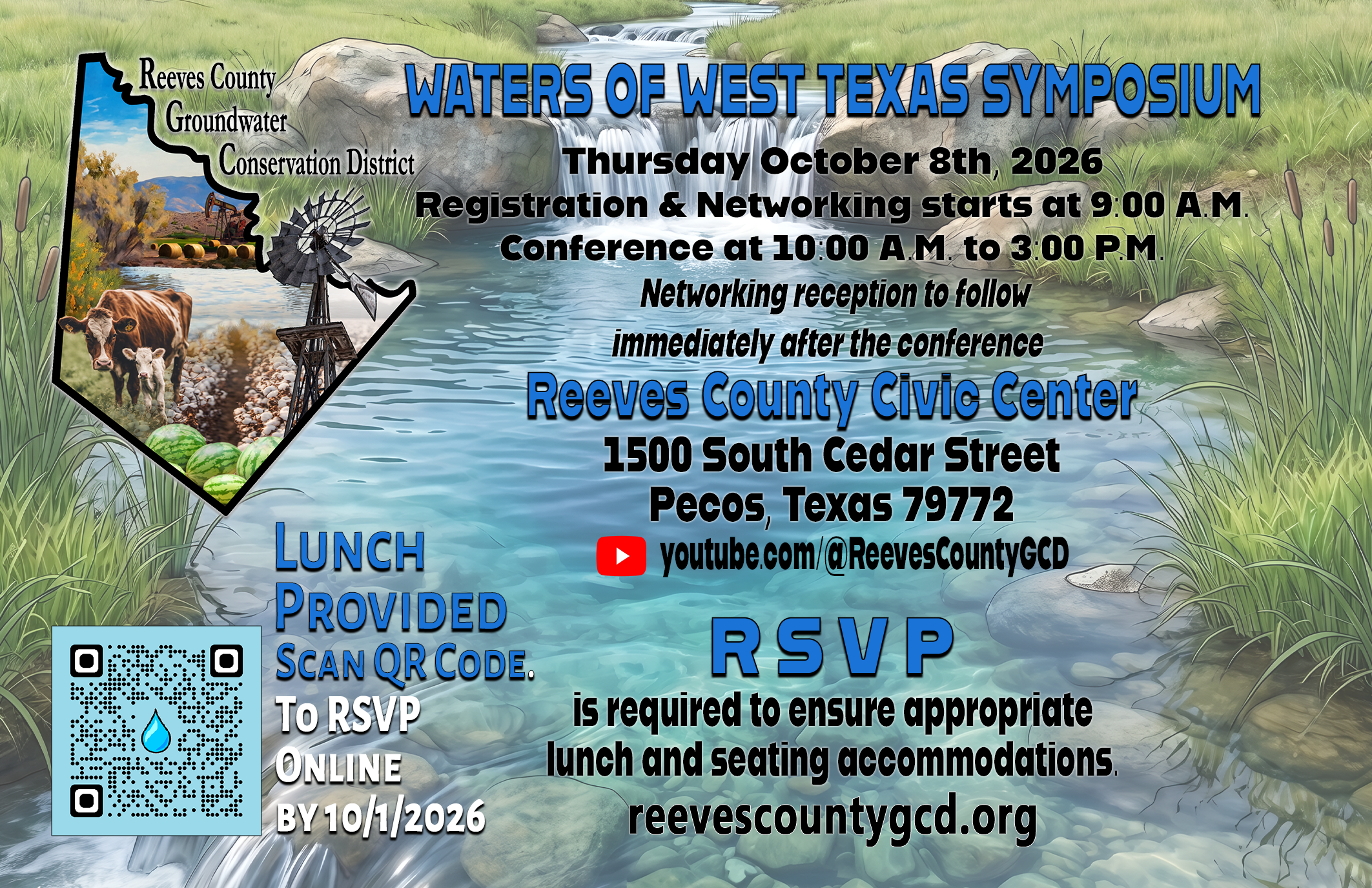
On Thursday, Perrin’s organization is hosting the Waters of West Texas Symposium at the Reeves County Civic Center from 10 a.m. to 3 p.m. with a half-dozen speakers lined up to address groundwater issues in west Texas.